Best Platforms to Sell Digital Products in 2026
Most roundups compare pure storefronts on fee percentage alone. Here's a fuller picture, including the platforms that also handle bookings, leads, and a real page, not just a checkout for a file.
Most “best platforms to sell digital products” lists compare the same handful of storefront tools on fee percentage and call it done. That misses the actual decision a lot of creators are making: not just “where do I sell a file,” but “where does my whole page live”: the links, the checkout, the booking if part of what I do is a service, and the people who aren’t ready to buy yet.
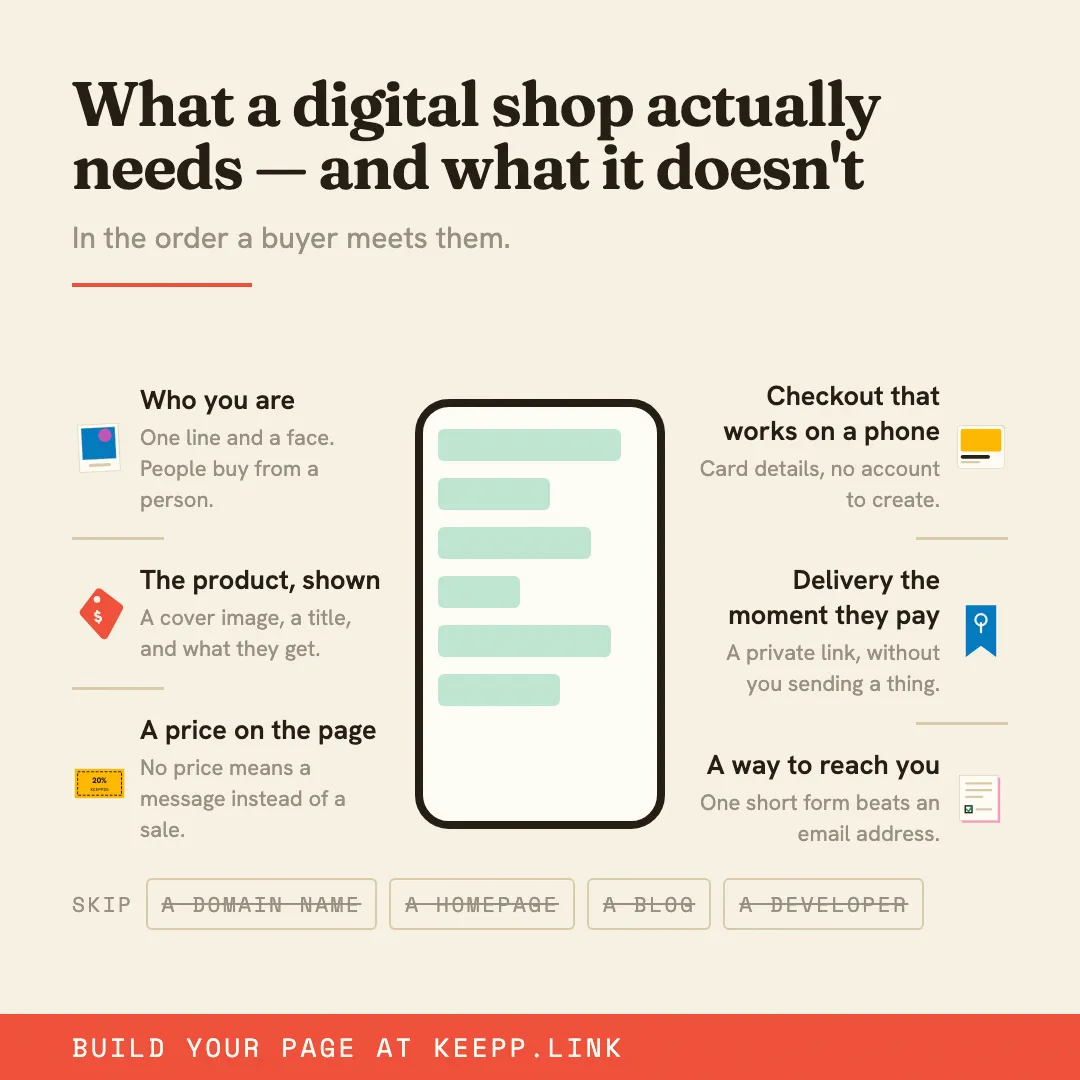
Here’s a fuller picture of the category, including where each platform’s actual strength sits.
One thing worth settling before you read the comparison: if your buyers already come from your own posts, you’re the one doing the discovery, and a platform’s cut buys you much less than the roundups assume. Where to sell digital products when you already have an audience works through that version of the decision.
Keepp: a full page, not just a storefront
Keepp starts at 5% on a free plan, dropping to 3% on Pro ($9.99/month) and 0% on Influencer ($24.99/month): the cheapest zero-commission plan in this list, against $99/month at Payhip. Real Stripe checkout is included from the free tier. What sets it apart in this list is scope: digital products, physical products, real bookings with calendar sync, and lead-capture forms all run on the same page, not four separate tools. If what you sell is only ever going to be a single digital file, a narrower tool might be simpler, but the moment a business also books calls, sells something physical, or wants to capture people who aren’t ready to buy yet, this is the platform built for that from the start. Selling products and digital downloads covers the mechanics.
Gumroad, the simplest pure digital-download checkout
No monthly subscription, Gumroad charges 10% + $0.50 per direct sale, plus card processing on top (roughly 12.9% + $0.80 combined), or a flat 30% through its own Discover marketplace. It’s genuinely simple for a creator who wants nothing but “upload a file, set a price.” A full breakdown, including its real strengths (a built-in affiliate program, a custom domain on every account) is in Keepp vs Gumroad.
Payhip, a storefront with a path to 0%
Three tiers: Free at 5%, Plus ($29/month) at 2%, Pro ($99/month) at 0%. The break-even to Plus lands around $967/month in sales. A solid pick for a creator whose entire business is digital products at real volume. Keepp vs Payhip has the full comparison.
Stan Store: flat monthly pricing, no percentage
$29/month (Creator) or $99/month (Creator Pro), with 0% platform fee regardless of volume. You pay Stripe’s own processing and nothing else. That flat structure genuinely wins on arithmetic once you’re doing serious monthly volume; below that, it’s a fixed cost whether or not the page earned anything that month. Worth noting the flat-fee route isn’t unique to Stan: Keepp’s Influencer plan is also 0%, at $24.99/month. Keepp vs Stan Store covers the exact break-even.
A dedicated course platform, for structured, paced learning
If a course genuinely has dozens of modules, per-lesson quizzes, or drip-fed pacing that unlocks one module a week, a platform built specifically for that structure, Teachable and Kajabi are the two most established, is the right category of tool. It’s a different job than selling a handful of video modules plus a workbook, which is where a private-delivery-link model like Keepp’s or Gumroad’s fits more simply. Selling online courses and community access covers what that private-link model looks like in practice.
Shopify, full e-commerce infrastructure
For a business running real physical inventory at scale (shipping zones, carrier integrations, warehouse management) a dedicated e-commerce platform is built for exactly that complexity, at a corresponding setup cost and monthly fee. Most creators and small businesses selling a handful of products or digital downloads don’t need that scale of tooling to get started.
What actually decides it
Fee percentage is the number every roundup leads with, but it’s not the whole decision. Three questions matter more than the headline rate:
What’s your actual volume? A flat monthly fee beats a percentage above a specific break-even point, and loses below it, Stan Store and Payhip’s comparisons both walk through the exact math.
Does the business need more than a checkout? A booking for a call, a lead form for people who aren’t ready yet, a physical product alongside a digital one: most pure storefront tools handle none of that, which means a second or third tool for anything outside the checkout itself.
Who holds the money? Keepp, Stan Store, and nas.com run checkout through your own connected payment account; several others in this category process payment through their own systems instead. A Keepp page never locks you in covers why that distinction matters beyond just fees.
Matching platform to business type
A course creator with a handful of video modules fits a private-delivery-link model (Keepp, Gumroad, or Payhip) more than a full LMS. A creator selling structured, paced courses with completion tracking fits a dedicated course platform. Someone whose business is also bookings, physical products, or leads, not just one digital file fits a full page like Keepp. A high-volume seller past the percentage break-even fits a flat 0% plan, Keepp’s Influencer at $24.99/month, Stan Store at $29, or Payhip’s top tier at $99.
Quick reference
| Free plan | Fee structure | Bookings | Lead forms | |
|---|---|---|---|---|
| Keepp | Yes, 5% | 5% → 3% → 0% | Yes, free plan | Yes, exportable |
| Gumroad | Yes | 10%+$0.50 + processing | No | Email subscribe only |
| Payhip | Yes, 5% | 5% → 2% → 0% | No | No |
| Stan Store | No (trial only) | 0% flat, $29-99/mo | Yes | Partial, gated |
Common questions
Do I need to commit to just one of these? No, plenty of sellers run a narrower tool for one specific product line alongside a Keepp page as the actual destination for everything else. A Keepp page never locks you in either way.
What if I’m not sure how much volume I’ll do? Start on whichever platform’s free tier covers what you need today, and revisit the fee math once you have real sales data, guessing at future volume before you have any is the most common way to overpay for a plan you don’t need yet.
Is the cheapest option always the best one? Not if it means adding a second or third tool for bookings, leads, or a physical product. Factor in what a second subscription and a second dashboard actually cost in time, not just money.
Where to start
Most digital-product sellers don’t yet know which category they’re in, and starting on a free plan that can hold a digital product, a physical one, a booking, and a lead form is a safer first move than committing to a narrower tool before the business shape is settled. Claim your page at keepp.link, free to start, no card required.
To see a finished shop page with paid and free downloads, look at Keepp for digital products.
Claim your page at keepp.link: free forever, live in minutes. See pricing for the full breakdown.