Where to Sell Digital Products When You Already Have an Audience
If your buyers come from your own posts, you're the one doing the discovery. That changes which platform actually makes sense, and what you should be paying for it.
Most advice about where to sell a digital product is written for someone with no audience at all. It assumes the hard part is being found, so it points you at whichever platform has the most shoppers browsing it, and treats the cut that platform takes as the cost of being introduced to them.
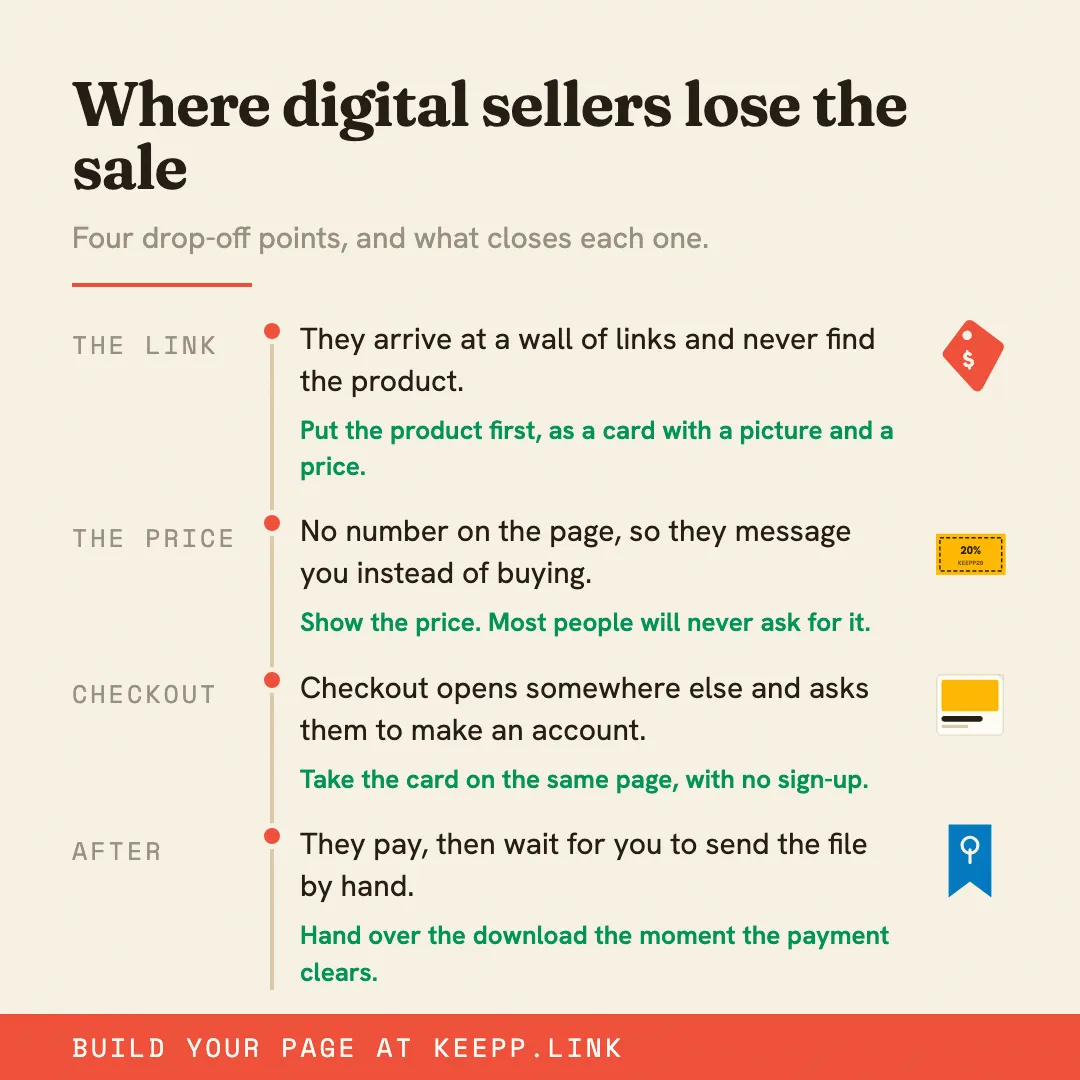
That’s a fair trade when it’s true. It stops being true the moment you’re the one doing the introducing.
If people find your product because you posted a Reel about it, pinned it, put it in a video description, or mentioned it in a thread, then the discovery already happened: on your account, in front of an audience you built, at your expense. The question worth asking isn’t “which platform has the most buyers.” It’s “where should the sale land, given that I already brought the buyer with me.”
Who actually found the customer
This is the whole decision, and it’s easy to answer honestly. Look at where your last ten sales came from. If most of them started with something you posted, you’re running distribution yourself.
A platform that charges for discovery is charging for work you did. It’s a reasonable price when a stranger stumbles across your listing while browsing. It’s a strange price to keep paying on the buyer who was already following you before they ever heard of that platform.
Which means the platform you pick should be judged on completely different criteria than the usual roundups use, not on how much traffic it might send you, but on how little it takes from traffic you send it, and how well it handles someone who arrives already convinced. Best platforms to sell digital products lays out how the main options in the category compare on exactly that, fees included.
What’s worth selling into that audience
Owning your distribution changes what sells, too. You’re not fighting for position in a search result against a thousand similar listings, so the generic, broadly-appealing product that’s built to catch a wide net is the wrong shape entirely. You want the opposite: something narrow enough that your specific audience recognises it as made for them.
The pattern in what’s currently selling well backs this up. A product framed for a precisely defined situation consistently outperforms the general version of the same thing: an “ADHD-friendly weekly meal planner for a family of four” against a “meal planner,” a “wedding-day timeline for photographers” against a “wedding checklist.” The narrower framing supports a higher price and competes with far less, because almost nobody bothers to make the specific version.
Bundling works on the same logic. A set of ten or fifteen related files priced together tends to outperform the same files sold individually, partly because it’s a better deal and mostly because it removes the buyer’s job of working out which one they need. What digital products are actually in demand goes deeper into where demand is currently moving, and the most profitable digital products to sell covers which formats hold up best.
The filter AI created
There’s one test worth running on any product idea before you build it: could a reasonably motivated buyer get something close enough by asking an AI tool for it?
If yes, it’s a hard sell now, and no amount of distribution fixes that. The categories that got hollowed out over the last few years were the ones a prompt could approximate: generic beginner guides, interchangeable stock imagery, lists of ideas, prompt packs. The hot-selling digital products AI quietly wiped out covers what happened to each of them.
What survived is what a prompt can’t produce: judgment about which option is actually right, a system refined across real work rather than described from the outside, and the fact that a specific person your audience already trusts is the one who made it. The digital products AI hasn’t taken over is the full version of that argument.
Here’s the part that connects back to distribution: every one of those surviving qualities is a reason to buy from you specifically. They don’t travel well through a marketplace listing, where you’re one anonymous seller among many. They travel perfectly through your own posts, where the audience already knows whose taste they’re buying.
One link, every platform
The practical problem with owning your distribution is that it’s spread across places that don’t talk to each other. An Instagram bio, a TikTok profile, a Pinterest pin, a YouTube description, an X bio: each one gets a link, and each platform limits what you can do with it.
A Keepp page solves that by being the one destination all of them point at. Putting your link in your bio covers the setup, but the shape is simple: one page holding everything you sell, linked from every profile you have, updated in one place when something changes.
Where it gets more useful is that the page isn’t the only thing you can share. Every product on it has its own real link and its own QR code, opening straight to that product rather than dropping someone at the top of a page to scroll. So a post about one specific planner can point directly at that planner, and when that link lands in a chat or a DM, the preview that unfurls carries that product’s own title, description and photo, not your homepage’s. Someone deciding whether to tap sees the actual thing you were talking about.
For anything physical or in-person, the QR code does the same job off-screen: on a card, a flyer, a table tent, a slide at the end of a talk.
The money arrives in your account
If you’re the one generating the demand, it matters where the proceeds land. Every Stripe sale on a Keepp page runs through your own connected Stripe account. You’re the merchant of record, not Keepp. The money is credited directly to you, and payouts, refunds and disputes all happen in your own Stripe dashboard on Stripe’s schedule. There’s no balance sitting with Keepp waiting to be released, because there was never a balance to hold.
That’s also what makes the arrangement genuinely yours. Stop using Keepp and your Stripe account and its whole payment history are unchanged. Keepp never locks you in covers the rest of what that means for your customer data and your page.
Keepp’s own commission is a flat cut taken at the moment of sale: 5% on the free plan, 3% on Pro at $9.99/month, and 0% on Influencer at $24.99/month. Real Stripe checkout is included from the free tier, with no separate charge for automatic delivery.
A page, not a checkout for one file
The other thing that changes when you bring your own audience: not everyone who arrives is ready to buy. Some are there for the free thing, some want to ask a question first, some want to book time with you.
A page built only to take payment for a file has nowhere to put those people. A Keepp page does: digital products, physical products, real bookings with calendar sync, and lead-capture forms all run on the same page. A free lead-magnet PDF can sit directly alongside the paid guide, each as its own product block with its own price and its own delivery.
So the same link in the same bio serves the buyer, the maybe-later, and the person who wants a call, without you running three tools to cover them.
Where to start
Work out where your last handful of sales actually came from. If the answer is your own posts, you’re already doing the expensive part, and the platform question becomes much simpler.
Build one narrow product for the audience you have, put it on a page you control, and point every profile you own at it. Sell a product walks through adding it with automatic delivery switched on.
Start at keepp.link: free to begin, real checkout included, and the money lands in your own Stripe account.