How to Write an Instagram Bio That Actually Converts Followers to Customers
A bio's job isn't to sound clever. It's to answer 'why should I tap that link' in under 150 characters. The formula, before-and-after rewrites, and how to test what's actually working.
Most advice about Instagram bios is about tone: sound witty, sound relatable, sound like a brand. None of that matters if a stranger scrolling past still doesn’t know what you do or why they’d tap your link. A bio’s actual job is narrower and more mechanical: answer “why should I tap that link” in under 150 characters, for someone who’s never seen your content before this exact post.
The three-part formula
Every bio that converts is doing three things, in some order:
- Who you help: the specific person, not “everyone.”
- What you offer: plainly stated, not implied through vibes.
- One clear action: a reason to tap the link, right now.
Miss the first and you attract the wrong followers. Miss the second and a real prospect scrolls past confused. Miss the third and the link just sits there, doing nothing no matter how good the rest of the bio is.
Specificity beats cleverness
“Candle magic ✨” is memorable in the way a lot of things are memorable: for a second, without telling anyone anything useful. “Hand-poured candles, shipped weekly” isn’t clever, but it answers the question a first-time visitor actually has: what is this, and does it apply to me. Specificity converts. Cleverness, on its own, doesn’t.
Emoji as signposts, not decoration
An emoji works when it separates one idea from the next at a glance: a 📍 before a location, a 🔗 before the call to action. It stops working the moment there are more emoji than words, because the bio goes from “quickly scannable” to “requires translation.” Use them to organize the three parts of the formula, not to fill space between them.
Before and after
Before: “living my best life 🌸 create • connect • inspire 🌸 link below”
This says nothing a stranger can act on, no who, no what, no real reason to tap the link.
After: “Helping new moms get back to feeling like themselves 🤍 free 15-min consult below”
Same energy, completely different function. Who (new moms), what (a specific kind of coaching, implied by the framing), and a clear action (a free consult, one tap away).
Before: “small biz owner 🧵 handmade with love 🧵 shop my stuff”
After: “Hand-embroidered patches, made one at a time 🧵 shop this week’s drop below”
The second version tells a stranger exactly what they’d be buying and gives them a reason to look now. “this week’s drop” implies something that changes, which is a reason to check back later even if they don’t buy today.
Matching the formula to the business type
A product seller’s bio leans on specificity about the product itself: what it is, how often it changes, why now. A service business’s bio leans on the outcome for the client and a low-commitment first step, usually a free call. A content creator monetizing recommendations leans on trust, why their picks are worth following, with the action being “shop my picks” rather than a direct sale. The formula’s three parts stay the same; which part carries the most weight shifts with what’s actually being sold.
Testing what’s actually working
A bio isn’t something to write once and forget, the only way to know if it’s converting is to look at what happens after someone reads it. If link clicks are healthy but nobody’s completing anything once they land, the bio is doing its job and the problem is downstream. If clicks themselves are low relative to profile visits, the bio isn’t giving people a reason to tap in the first place, worth rewriting the action line before touching anything else.
One more before and after
Before: “book club vibes only 📚 curating my faves”
This reads as a personal account, not a business, no indication anything is for sale, no action for a visitor to take.
After: “Curated reading lists + tools for people who want to read more 📚 shop the list below”
Now it’s clear there’s something to buy, who it’s for (people trying to read more), and where to go.
Common questions
How often should I revisit my bio? Whenever the business itself changes in a way that affects the offer or the action: a new main product, a shift from one-time sales to bookings, a different primary audience. A bio that’s still accurate doesn’t need to change just for the sake of freshness.
Can a bio be too short? Only if it skips one of the three parts. A bio can be four words and still convert if those four words cover who, what, and action, brevity isn’t the problem; missing a part is.
The bio’s promise has to match the link
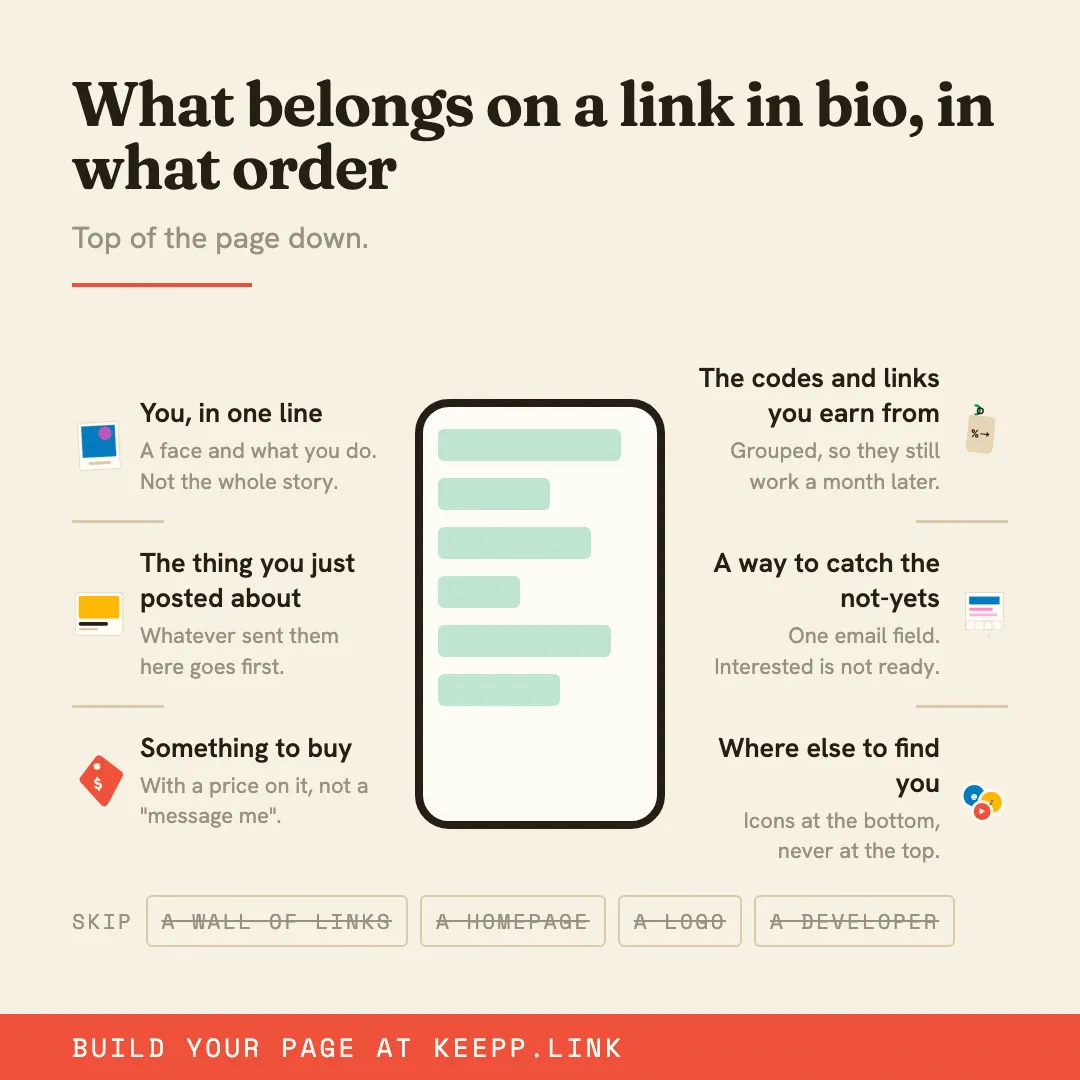
A bio promising “shop below” that leads to a page of scattered links with the actual shop buried three taps deep breaks the promise the bio just made, and that mismatch is often where a genuinely good bio still fails to convert. Every product is a shareable link covers making sure what’s on the other side of the tap is exactly what the bio said it would be, and put your link in your bio covers the setup.
Rewriting your own bio, step by step
- Write down, in plain language, who you help and what you actually offer, no branding, just the facts.
- Cut it down to the fewest words that still say both things clearly.
- Add one action verb pointed at the link, shop, book, grab, join.
- Read it as if you’re seeing the account for the first time. Does it answer “why tap this link”?
- Publish it, then check link clicks over the next week against what you had before.
Where to start
Write the three parts (who, what, one action) before worrying about tone. A plain, specific bio that delivers on its promise outperforms a clever one that doesn’t, every time. 100+ Instagram bio ideas for small businesses and creators who sell has ready-to-adapt examples across product sellers, service businesses, local shops, and course creators if you want a starting point rather than a blank page.
Build the page your bio points to at keepp.link: free to start, live in minutes.